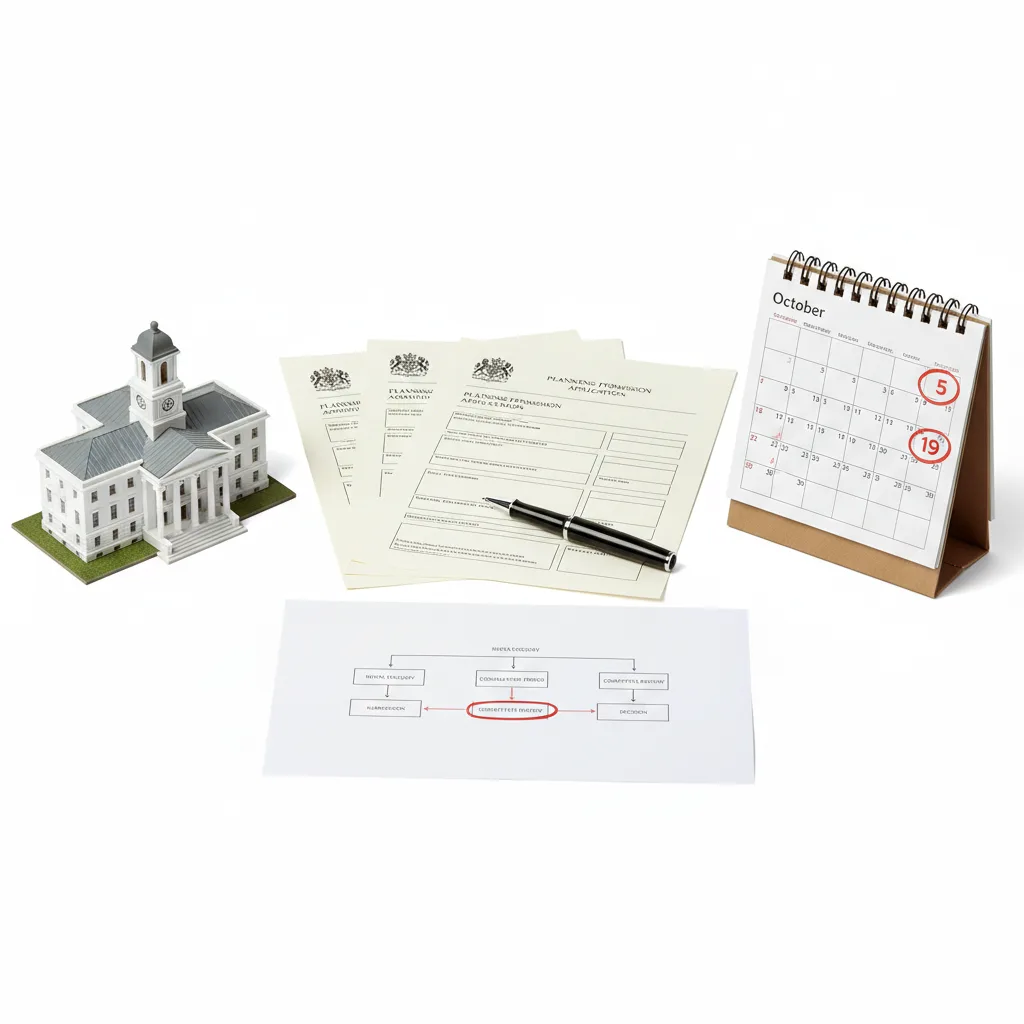
The UK planning permission process follows six key stages: pre-application advice, application submission, council validation, 21-day public consultation, officer assessment, and a decision within 8 weeks (householder) or 13 weeks (major). Applications are submitted via the Planning Portal, with fees starting at £258 for householder proposals. Around 83% of applications are approved nationally (DLUHC, 2024), and planning permission lasts 3 years once granted. This guide walks you through every stage of the process, from your first enquiry to the decision notice.
Stage 1: Pre-Application Advice
🔍 Affected by this? Check planning applications near you — Search your postcode free →
Key Planning Process Statistics (England, 2024)
- 471,000 planning applications received annually (DLUHC)
- 83% approval rate nationally
- ~90% of decisions made by officers under delegated powers
- Householder application fee: £258 | New dwelling: £578 per unit
- Statutory determination: 8 weeks (householder/minor) or 13 weeks (major)
- Planning permission valid for 3 years from decision date
Before you submit anything, most councils offer a pre-application advice service. This is an informal (and usually paid) consultation with a planning officer about your proposal before you commit to a formal application.
Why It's Worth It
- You get an honest steer on whether your proposal is likely to be supported
- The officer will flag policy conflicts early, saving you time and money
- You can adjust your plans before submitting, increasing your chances of approval
- It demonstrates engagement with the process, which committees look on favourably
What to Expect
Pre-application advice isn't binding — the council can still refuse your application even if the pre-app response was positive. But it's the closest thing to a preview of the outcome you'll get.
Fees vary by council and the scale of the proposal. A householder pre-app might cost £50-£250. Major development pre-apps can cost several thousand pounds.
Most councils will respond within 4-6 weeks with a written assessment, though some are faster.
Stage 2: Preparing and Submitting Your Application
What You'll Need
A planning application typically requires:
- Completed application form — most applications are submitted through the Planning Portal (planningportal.co.uk), though some councils accept direct submissions
- Site location plan — at 1:1250 or 1:2500 scale, with the site edged in red
- Site/block plan — at 1:200 or 1:500 scale showing the proposal in context
- Existing and proposed floor plans and elevations — usually at 1:50 or 1:100
- Design and Access Statement — required for most applications except householder ones and changes of use (though some councils welcome them voluntarily)
- Planning fee — set nationally by the Town and Country Planning (Fees for Applications, Deemed Applications, Requests and Site Visits) (England) Regulations 2012 (as amended). A householder application currently costs £258. Major applications cost significantly more. For a full breakdown of all fees and additional costs, see How Much Does Planning Permission Cost?.
- Ownership certificates — you must declare who owns the land. If you don't own all of it, you need to serve notice on the owners (Certificate B, C, or D).
- Supporting documents — depending on the proposal, you may need a flood risk assessment, ecological survey, heritage statement, tree survey, transport statement, contamination assessment, or other specialist reports.
The CIL (Community Infrastructure Levy)
If your development creates new floor space (typically over 100 square metres or creates a new dwelling), you may be liable for CIL. This is a charge levied by the council to fund local infrastructure. CIL is calculated at a rate per square metre set by each charging authority and is payable upon commencement of development — not at application stage.
Stage 3: Validation and Registration
Once the council receives your application, they check it's complete. This is called validation.
What They Check
- Is the form filled in correctly?
- Are all the required plans and documents included?
- Has the correct fee been paid?
- Have ownership certificates been completed properly?
If anything is missing, the council will write to you with a validation checklist of what's needed. Your application won't be registered — and the clock won't start — until it's valid.
Once Validated
Your application gets a reference number and is added to the planning register. This is the moment it becomes a public document. Anyone can view it, and the consultation period begins.
PlanWatch monitors council planning registers and can notify you when new applications appear near an address you're watching — useful whether you're the applicant keeping an eye on competing developments, or a neighbour wanting to stay informed. Planning processes vary by council — for example, Manchester City Council and Leeds City Council each have their own local validation requirements on top of the national standard.
Stage 4: Consultation and Publicity
The council is legally required to publicise your application under the Town and Country Planning (Development Management Procedure) (England) Order 2015. Depending on the type of application, this involves some or all of:
- Neighbour notification letters — sent to adjoining properties
- Site notices — posted on or near the site
- Press notices — published in a local newspaper (required for major applications, listed building applications, and those affecting a right of way or conservation area)
The Consultation Period
The standard consultation period is 21 days from the date of notification. During this time:
- Neighbours and the public can view the application and submit comments (support or objection)
- Statutory consultees respond — these might include the highways authority, the Environment Agency (for flood risk), Natural England, Historic England, the parish council, and others depending on the nature of the proposal
- The case officer may visit the site
For guidance on making effective objections, see our guide on How to Object to a Planning Application.
Stage 5: The Determination Period
The council has a set period to determine (decide) your application. These statutory timescales are enshrined in the DMPO and form part of the government's performance monitoring:
| Application Type | Determination Period |
|---|---|
| Householder applications | 8 weeks |
| Minor applications (1-9 dwellings, under 1,000 sqm commercial) | 8 weeks |
| Major applications (10+ dwellings, 1,000+ sqm, sites over 1 hectare) | 13 weeks |
| Applications subject to Environmental Impact Assessment (EIA) | 16 weeks |
These are measured from the date of validation, not submission. For a detailed breakdown of what affects these timescales in practice, see How Long Does Planning Permission Take?.
Extensions of Time
In practice, many applications take longer than these periods. The council may ask you to agree an extension of time — a voluntary agreement to allow more time for negotiation or to resolve outstanding issues. It's usually worth agreeing, because the alternative is the council refusing the application to meet their deadline, or you appealing for non-determination.
If the council fails to determine your application within the relevant period (or any agreed extension), you have the right to appeal to the Planning Inspectorate as if the application had been refused. This is called a non-determination appeal under Section 78 of the Town and Country Planning Act 1990.
Stage 6: Assessment and Officer Report
While the public consultation is running, the case officer is assessing your application. This involves:
Policy Assessment
The officer checks your proposal against:
- The development plan — this includes the Local Plan (and any Neighbourhood Plan) adopted by your council. Under Section 38(6) of the Planning and Compulsory Purchase Act 2004, decisions must be made in accordance with the plan unless material considerations indicate otherwise.
- The National Planning Policy Framework (NPPF) — the government's overarching planning policy.
- Supplementary Planning Documents (SPDs) — additional guidance adopted by the council on specific topics (design, parking standards, affordable housing, etc.).
Material Considerations
The officer weighs all material planning considerations, including representations from the public and consultee responses.
Site Visit
The officer will usually visit the site to assess the proposal in context. This is standard and doesn't indicate a problem.
The Officer Report
The officer writes a formal report setting out:
- A description of the proposal and the site
- The relevant planning history
- A summary of consultation responses
- An assessment against each relevant policy
- Their overall conclusion and recommendation (approve or refuse)
This report is a public document and is typically available on the council's planning portal before the decision is made (or before committee, if it goes that route).
Stage 7: The Decision — Delegated or Committee?
Delegated Decisions
The vast majority of planning applications — around 90-95% — are decided by planning officers under delegated powers. This means the head of planning (or equivalent) authorises the officer to issue the decision without it going to the elected planning committee.
Delegated decisions are faster and based purely on planning merits. Each council has a scheme of delegation that sets out when an officer can decide and when the application must go to committee.
Planning Committee
Applications go to committee when:
- They're major applications or considered significant/sensitive
- A councillor calls them in (requests committee determination)
- There are a significant number of objections contrary to the officer's recommendation
- The officer is recommending approval against policy (a departure from the development plan)
- The applicant or a close relative is a council employee or councillor
At committee, elected members debate the application based on the officer report, any representations, and sometimes presentations from the applicant and objectors. Members then vote to approve, refuse, or defer the application. They can go against the officer's recommendation, but they must give clear planning reasons for doing so.
Stage 8: Conditions and Section 106 Agreements
If your application is approved, it will almost certainly come with conditions. These are legally binding requirements attached to the permission.
Common Conditions
- Time limit — you must start development within 3 years (this is standard under Section 91 of the Town and Country Planning Act 1990)
- Approved plans — the development must be carried out in accordance with the approved drawings
- Materials — details of external materials to be submitted and approved before use
- Landscaping — a scheme of planting to be submitted and implemented
- Drainage — surface water drainage details
- Hours of construction — typically restricting noisy work to weekday daytime hours
- Obscure glazing — windows facing neighbouring properties to be fitted with obscure glass
Pre-Commencement Conditions
Some conditions must be discharged (approved) before you start building. These are called pre-commencement conditions, and under legislation introduced in 2018, the council must get your written agreement before imposing them. Starting work without discharging pre-commencement conditions invalidates the permission.
Section 106 Agreements
For larger developments, the council may require a Section 106 agreement (also called a planning obligation) under Section 106 of the Town and Country Planning Act 1990. These are legal agreements requiring the developer to provide things like:
- Affordable housing
- Financial contributions to education, highways, or healthcare
- On-site open space or play facilities
- Travel plans or highway improvements
Section 106 agreements are negotiated between the applicant and the council and are registered as a charge on the land. For a full guide to what these agreements cover and how they're negotiated, see Section 106 Agreements Explained.
Stage 9: The Decision Notice
The decision notice is the formal document issued by the council confirming whether your application has been approved or refused.
If Approved
The notice will list all conditions. Read them carefully — some require action before you can start building. The permission runs with the land, not the applicant, so it benefits future owners too.
If Refused
The notice will list the reasons for refusal, each referencing specific planning policies. These reasons are crucial if you're considering an appeal — they define exactly what the council found unacceptable. For a full overview of common refusal grounds and how councils make these decisions, see Can Planning Permission Be Refused?.
You have the right to appeal a refusal to the Planning Inspectorate. For householder applications, the deadline is 12 weeks. For most other applications, it's 6 months. See our guide on How to Appeal a Planning Decision.
Timeline Overview
Here's a realistic timeline for a typical householder application:
| Stage | Duration |
|---|---|
| Pre-application advice | 4-6 weeks |
| Preparing application and drawings | 2-4 weeks |
| Validation | 1-2 weeks |
| Consultation period | 3 weeks (21 days) |
| Officer assessment and report | 2-4 weeks |
| Decision (delegated) | Within 8 weeks of validation |
| Total (straightforward case) | Roughly 3-4 months |
For committee decisions, add 2-6 weeks depending on the meeting schedule. For major applications, the entire process can take 6-12 months or longer.
Frequently Asked Questions
How much does planning permission cost?
For householder applications in England, the fee is currently £258 (set to increase periodically). Other fees vary: a new dwelling costs £578; major residential developments cost £578 per dwelling up to 50, then different rates above that. Full fee schedules are published by the government and available on the Planning Portal.
Can I start building before the decision?
At your own risk. If the application is refused, you'd have to remove whatever you've built. In practice, this almost never makes sense. Wait for the decision notice.
What if the council takes too long?
If the statutory determination period passes without a decision (and you haven't agreed an extension of time), you can appeal on grounds of non-determination under Section 78 of the Town and Country Planning Act 1990. The Planning Inspectorate will then decide the application on its merits.
Do I need an architect?
There's no legal requirement to use an architect or planning agent, but professional drawings and a well-prepared application are significantly more likely to be approved — and approved faster. For simple householder applications, a competent architectural technician or designer is usually sufficient.
Is planning permission the same as building regulations?
No. They're entirely separate regimes. Planning permission controls what you can build and where. Building regulations (administered under the Building Act 1984) control how it's built — structural safety, fire, insulation, drainage, etc. You may need both, either, or neither depending on what you're doing.
Summary
The planning permission process follows a clear, logical sequence: pre-application advice, submission, validation, consultation, assessment, and decision. Understanding each stage gives you a huge advantage — whether you're the applicant wanting a smooth process or a neighbour wanting to know when and how to have your say.
The biggest delays usually come from incomplete applications (validation bounces), missing supporting documents, and unresolved consultee objections. Get these right at the start, and the process can be remarkably straightforward.
This guide was researched and written by the PlanWatch team. PlanWatch monitors planning applications across 300+ UK councils.
Check Your Area
Don't wait until it's too late. Search your postcode to see all planning applications near you.
Further Reading
Related Guides
- planning enforcement when rules are broken
- Planning Application for a Phone Mast Near My Home
- Do I Need Planning Permission for a Fence?
- How to Appeal a Planning Decision
- Permitted Development Rights Explained
Check Planning in Your Area
- Leeds Planning Applications
- Manchester Planning Applications
- Birmingham City Council Planning Applications
- Bristol Planning Applications
Browse Planning by Region
Planning fees, timescales, and local policies vary across the UK. England, Scotland, Wales, and Northern Ireland each have different planning frameworks and fee structures.
- Planning in London — 32 boroughs, higher fees for major applications, Mayor call-in powers
- Planning in the South East — High demand, Green Belt constraints, longer determination times
- Planning in Scotland — Separate planning system, different fee structure and application types
- Planning in Wales — Welsh planning system under Planning Policy Wales, different fees to England
- Planning in Northern Ireland — Separate system, 11 district councils handle planning
Want to know if there's a planning application near you?
Enter your postcode to see what's been submitted in your area — completely free.
Search Your Postcode FreeDisclaimer: PlanWatch provides general information about UK planning processes. This content is not legal advice. Planning law is complex and varies by local authority. Consult a qualified planning consultant or solicitor for advice specific to your situation.