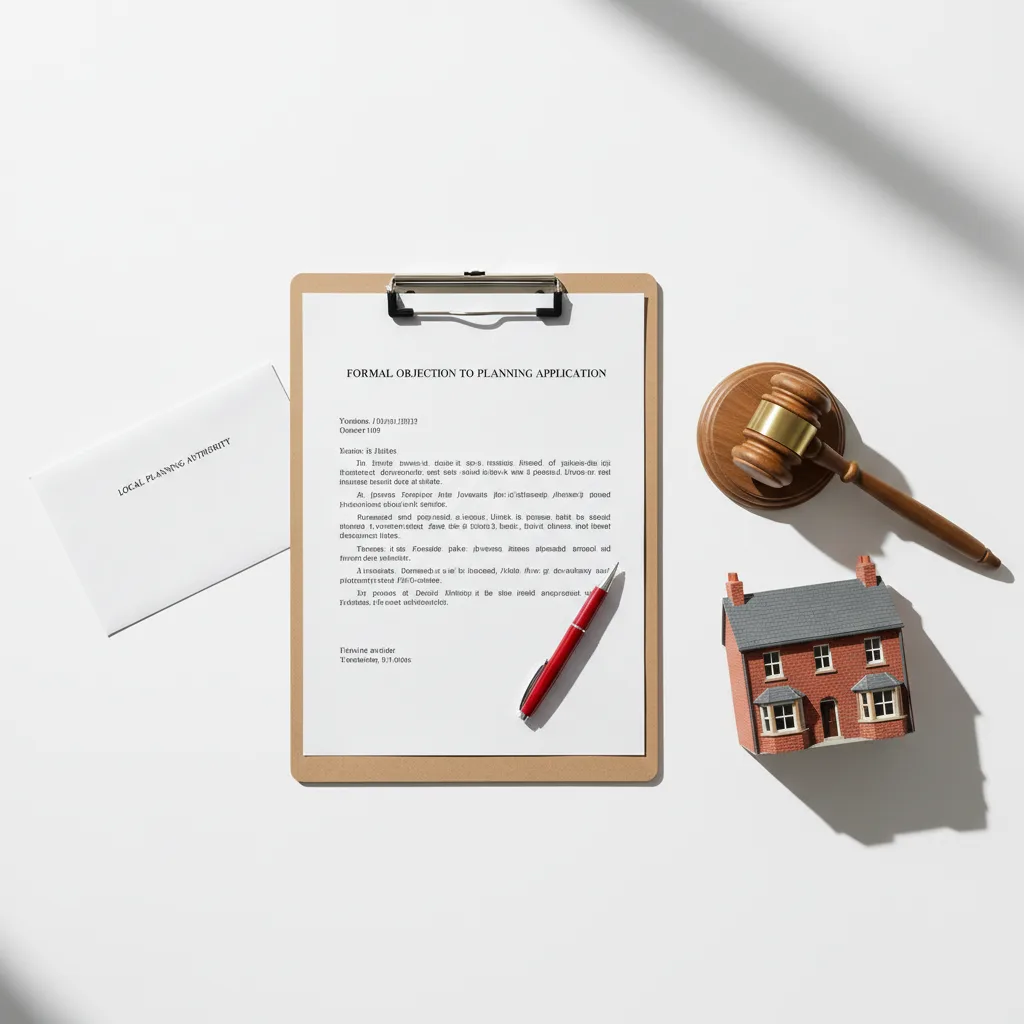
You can object to any planning application by submitting written representations to your local planning authority (LPA) within the 21-day consultation period. Your objection must be based on material planning considerations — not personal opinions or property value concerns. Around 83% of applications are approved nationally (DLUHC, 2024), but well-evidenced objections citing specific policy conflicts can and do influence outcomes. This guide explains exactly what counts as a valid objection, how to write one effectively, and what happens after you submit it.
The 21-Day Consultation Window
🔍 Affected by this? Check planning applications near you — Search your postcode free →
Key Planning Objection Statistics (England, 2024)
- 471,000 planning applications received nationally (DLUHC)
- 83% overall approval rate — objections matter most on marginal cases
- Applications with 10+ objections are typically referred to committee
- 21-day statutory consultation period (Town and Country Planning Act 1990)
- ~30% of planning appeals are allowed (Planning Inspectorate Annual Report)
- Only the applicant can appeal a refusal — objectors cannot appeal an approval
When a planning application is submitted to your local council, the council is required to publicise it. Under the Town and Country Planning (Development Management Procedure) (England) Order 2015, they must do at least one of the following:
- Write to you directly — a neighbour notification letter sent to adjoining properties
- Put up a site notice — a yellow or white notice on or near the site
- Place a notice in a local newspaper — typically for larger or more sensitive applications
From the date of notification, you usually have 21 days to submit your comments. Some councils allow slightly longer, but 21 days is the statutory minimum and most stick to it.
Don't miss this window. Late comments may still be accepted if the case officer hasn't yet written their report, but there's no guarantee. If you spot an application after the deadline, submit your comments anyway — councils have discretion to consider them, and many will.
Tools like PlanWatch can alert you as soon as new applications are submitted near your property, so you never have to rely on spotting a site notice or waiting for a letter that might not come.
What Counts as a Material Planning Consideration
What is a material planning consideration?
A material planning consideration is any factor relating to the use and development of land that a local planning authority (LPA) must legally weigh when determining a planning application. The concept derives from Section 70(2) of the Town and Country Planning Act 1990 and Section 38(6) of the Planning and Compulsory Purchase Act 2004. Examples include: amenity impact, design, highway safety, flood risk, ecology, and heritage.
This is the single most important thing to understand. Your objection will only carry weight if it raises material planning considerations — the factors that planning law says the council must take into account when deciding an application.
Note: Before raising an objection, check whether the proposed works might fall within permitted development rights. If they do, no planning application is required and a formal objection won't apply — though you can still report breaches to the council if the PD limits are exceeded.
The concept comes from Section 70(2) of the Town and Country Planning Act 1990 and Section 38(6) of the Planning and Compulsory Purchase Act 2004, which require councils to make decisions in accordance with the development plan unless material considerations indicate otherwise.
Material planning considerations include:
- Impact on the character and appearance of the area — does the proposal look out of place?
- Loss of privacy or overlooking — will new windows look directly into your home or garden?
- Loss of daylight or sunlight — will the building block natural light to your property?
- Noise and disturbance — during construction and from the proposed use
- Traffic, parking, and highway safety — will it create dangerous access or parking problems?
- Flood risk and drainage — could it increase surface water flooding?
- Impact on heritage assets — listed buildings, conservation areas, scheduled monuments
- Ecology and biodiversity — protected species, trees, hedgerows
- Design and visual amenity — does it comply with local design policies?
- Compliance with the local plan and national policy — does it conflict with adopted planning policies?
For a deeper dive into each of these, see our guide on What Are Material Planning Considerations. It's also worth understanding the grounds on which planning permission can be refused — objections that mirror these refusal grounds are the most effective.
What Does NOT Count
This is where most objections fall apart. The following are not material planning considerations, and raising them will weaken your credibility:
- Loss of property value — planning law does not protect the value of your home. Full stop.
- Loss of a private view — there is no right to a view in planning law (though loss of an important public view can be material, and overlooking/privacy is different from "view")
- Competition between businesses — a new shop competing with yours is not a planning matter
- Personal disputes with the applicant — your relationship with your neighbour is irrelevant
- Restrictive covenants — these are private legal matters, not planning considerations
- The applicant's motives or morals — planning considers the proposal, not the person
- "It's always been that way" — the fact that something hasn't been built before doesn't mean it can't be
Raising these issues doesn't just waste time — it can actually undermine your objection. Case officers may take the rest of your comments less seriously if they're mixed in with irrelevant complaints.
How to Write an Effective Objection Letter
A good objection is structured, specific, and grounded in planning policy. Here's a template structure that works:
Recommended Structure
Opening paragraph:
State your name, address, and the application reference number. Explain your relationship to the site (e.g., "I live immediately adjacent to the application site" or "My property overlooks the proposed development").
Paragraph 2 — Your key concern:
Lead with your strongest material planning consideration. Be specific. Instead of "it will cause traffic problems," say "The proposed development would add an estimated 20 vehicle movements per day to a single-track lane with no passing places, contrary to Policy T3 of the Local Plan."
Paragraphs 3-5 — Supporting concerns:
Address each material consideration in its own paragraph. Reference specific planning policies where you can — check your council's Local Plan, which is usually available on their website.
Closing paragraph:
Summarise your position and state clearly what you're asking for. For example: "For the reasons set out above, I respectfully request that this application is refused" or "I request that if permission is granted, conditions are imposed to [specific request]."
Tips for Effectiveness
- Be concise. A focused two-page letter beats a rambling ten-page one.
- Reference specific policies. Mentioning "Policy DM15 of the Local Plan" shows you've done your homework. Officers notice.
- Include evidence where possible. Photos of existing traffic problems, records of flooding, measurements showing loss of light.
- Be respectful. Officers are professionals doing their job. Hostile letters get read, but they don't get extra weight.
- Don't repeat what others have said. If your neighbours are also objecting, coordinate. Ten identical letters count as one point; ten letters raising different valid concerns count as ten.
How to Submit Your Objection
| Submission Method | Speed | Reliability | Best For |
|---|---|---|---|
| Online (Planning Portal) | Instant | Highest — logged automatically | Most objections |
| Email to planning dept | Same day | Good — keep sent receipt | Detailed objections with attachments |
| Letter by post | 2-3 days | Lower — allow for postal delays | Those without internet access |
| Speaking at committee | At meeting | N/A — supplements written objection | High-profile or contested applications |
You have three main options:
1. Online (Recommended)
Most councils use the Planning Portal or their own online system. Search for the application by reference number or address, and use the "comment" or "make a representation" function. This is the fastest and most reliable method — your comment is logged instantly. Submission processes vary slightly by council — for example, Manchester City Council and Birmingham City Council each have their own planning portals alongside the national Planning Portal.
2. Email
Send your objection to the planning department, quoting the application reference number in the subject line. Find the case officer's email on the application page, or use the general planning email address on your council's website.
3. Letter
Write to the planning department at your council's offices. Include the application reference number prominently. Allow time for postal delivery — remember the 21-day deadline.
Whichever method you choose, keep a copy of your submission and note the date you sent it.
What Happens After You Object
Your objection doesn't trigger an automatic refusal — it's one factor in the decision. Here's what happens next:
Your comments are logged on the planning file and become a public document (your name and address will be visible, but councils should redact phone numbers, emails, and signatures).
The case officer reads all representations. They're required to summarise the issues raised in their officer report.
The officer assesses the application against the development plan and all material considerations, including your objection.
A decision is made either by the case officer under delegated powers (the vast majority of applications) or by the planning committee. If a significant number of objections are received, the application is more likely to go to committee — but this varies by council.
You're notified of the decision, though not always promptly. Check the council's planning portal for updates.
If the application is approved despite your objection, you don't have a right of appeal — only the applicant can appeal a refusal. See our guide on How to Appeal a Planning Decision for more on this. The applicant may alternatively choose to resubmit with amendments — the first resubmission within 12 months is free. For a full breakdown of planning fees and resubmission costs, see How Much Does Planning Permission Cost?. Your remaining option would be judicial review, which is expensive and only available on narrow legal grounds.
Speaking at Planning Committee
If the application goes to the planning committee, you may be able to speak. Most councils allow registered objectors to address the committee for three to five minutes (varies by authority).
How to Prepare
- Register in advance. Most councils require you to register to speak at least 24-48 hours before the meeting.
- Be brief and focused. You'll have very limited time — pick your two or three strongest points.
- Don't read a script verbatim. Speak naturally with notes. Committees respond better to genuine communication.
- Stick to planning matters. The chair will cut you off if you stray into non-material issues.
- Bring visual aids if allowed. Some committees permit photos or plans to be shown.
- Don't repeat the officer's report. The committee members will have read it. Add new information or emphasise what the report got wrong.
Remember, committee members are elected councillors, not planning professionals. Explain things clearly without being condescending.
Frequently Asked Questions
Can I object anonymously?
Not effectively. Councils require a name and address with objections, and these become part of the public planning register. Some councils will withhold your details if you have genuine safety concerns, but this is at their discretion and rare.
Do petitions work?
A petition counts as a single objection regardless of how many people sign it. Individual letters raising different material concerns are far more effective. If you're organising a group, encourage each person to write their own letter focusing on the issues that matter most to them.
Can I object to a retrospective application?
Yes. A retrospective application (where development has already taken place) is assessed in exactly the same way as any other application. The fact that something has already been built doesn't mean it has to be approved.
What if my council approves the application despite strong objections?
If you believe the decision was made unlawfully — for example, the council failed to consider a material consideration or the process was procedurally flawed — you may be able to seek a judicial review. This must be brought within six weeks of the decision and requires legal advice. It's a challenge to the process, not a re-run of the planning merits.
Does the number of objections matter?
Not officially. One well-argued objection on planning grounds carries more weight than a thousand that say "I don't want it." However, a large number of objections often means the application will be decided by the planning committee rather than delegated to an officer, which introduces political accountability.
Summary
Objecting to a planning application is your democratic right, and when done properly, it can genuinely influence the outcome. The key is to focus on material planning considerations, be specific, reference planning policy, and submit on time. Skip the emotional arguments, no matter how strongly you feel — they don't carry weight in planning law.
Write clearly, stick to the facts, and make the case officer's job easier by showing exactly which policies the proposal conflicts with. That's how you make your objection count.
This guide was researched and written by the PlanWatch team. PlanWatch monitors planning applications across 300+ UK councils.
Check Your Area
Don't wait until it's too late. Search your postcode to see all planning applications near you.
Further Reading
Related Guides
- What Are Material Planning Considerations?
- My Neighbour is Building a Garden Room / Outbuilding
- neighbour building extension
- Planning Application for a Phone Mast Near My Home
- My Neighbour's Extension is Blocking My Light
Check Planning in Your Area
- Leeds Planning Applications
- Manchester Planning Applications
- Birmingham City Council Planning Applications
- Bristol Planning Applications
Browse Planning by Region
Planning decisions are made by your local council, and policies vary widely across the UK. Understanding your local planning framework strengthens any objection.
- Planning in London — 32 boroughs with distinct local plans and Article 4 directions
- Planning in the South East — Green Belt pressure, high-demand housing areas
- Planning in the North West — Major regeneration schemes, Manchester spatial framework
- Planning in the West Midlands — Birmingham growth, HS2 corridor planning
- Planning in Wales — Separate Welsh planning system under Planning Policy Wales (PPW)
Turn this guide into your objection letter — £9.99
Tell the Objection Letter Builder which application concerns you and why, and it drafts a formal letter around the material planning considerations covered here — ready to review and submit to your council. One-off £9.99, free on Pro & Business plans.
Build my objection letterWant to know if there's a planning application near you?
Enter your postcode to see what's been submitted in your area — completely free.
Search Your Postcode FreeDisclaimer: PlanWatch provides general information about UK planning processes. This content is not legal advice. Planning law is complex and varies by local authority. Consult a qualified planning consultant or solicitor for advice specific to your situation.