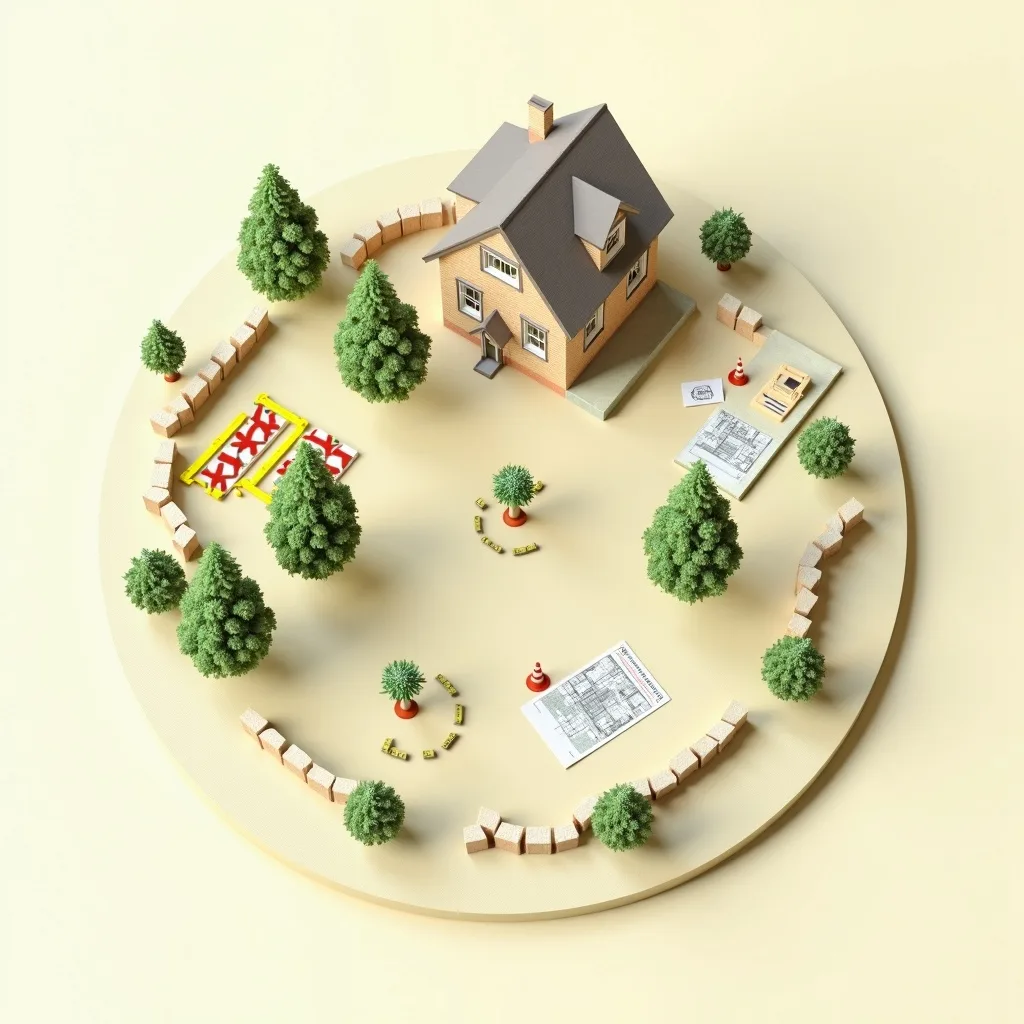
A root protection area (RPA) is the zone of ground around a tree that must be protected from disturbance during construction so the tree survives — under BS 5837:2012 it is a circle with a radius of 12 times the tree's stem diameter, capped at 707 square metres.
If your project is anywhere near a tree, the RPA is the single most important number on the plan. It is where much of the design tension lives, and it is what a tree officer looks at first. This guide explains what it is, how it is worked out and why it exists; for the full maths and worked examples, see how to calculate a root protection area. The RPA is one output of a full root protection area survey.
What an RPA actually represents
The RPA is a notional below-ground area — a proxy for the minimum volume of soil and roots a tree needs to stay healthy. It is defined in BS 5837:2012, the British Standard for trees in relation to design, demolition and construction.
Crucially, it is calculated from the tree's stem diameter (measured at 1.5m above the ground, sometimes called DBH), not from the spread of its branches. The standard formula is a circle with a radius of 12 times the stem diameter.
| Tree type | RPA rule |
|---|---|
| Standard tree | Radius = 12 × stem diameter (at 1.5m) |
| Very large tree | Area capped at 707 m² (≈ 15m radius) above ~1.25m stem diameter |
| Veteran / ancient tree | 15 × stem diameter, or canopy + 5m, whichever is larger |
| Multi-stem tree | Uses a combined notional stem diameter |
Worked example. A mature tree with a 0.5m (500mm) stem diameter gives a radius of 12 × 0.5 = 6 metres, an area of about 113 m² — a 12-metre-wide circle of ground you cannot dig, compact or build on without justification. Double the stem to 1.0m and the radius jumps to 12m and the area to roughly 452 m². That non-linear growth is why big trees dominate a site.
The RPA does not have to stay a perfect circle. Where an arboriculturist can show roots are growing asymmetrically — for example because a building or road already blocks one side — the same area can be re-plotted as a polygon that reflects the real rooting pattern. The area is preserved; the shape is redistributed to where roots actually are.
Why the RPA exists
Trees are far more fragile below ground than they look above it. Three facts drive the whole concept:
- Roots are shallow and wide. The fine roots that absorb water and nutrients mostly sit in the top 600mm of soil and commonly spread well beyond the canopy edge. The visible tree is a poor guide to where its roots are.
- Root damage is invisible and delayed. A tree whose roots are severed or suffocated can look fine for one or two seasons, then decline and die. By then the building is finished and the cause is easy to deny — so the protection has to be preventive, not reactive.
- Ordinary construction is lethal to roots. Tracking a digger back and forth compacts soil and squeezes out the air roots need. Trenching for foundations, drains or cables cuts them. Raising ground levels smothers them; lowering levels removes them. Spilt cement, fuel or diesel poisons them.
The RPA draws a line around all of that. Inside it, the default rule is: no excavation, no compaction, no level change, no storage of materials or spoil, no contamination. On site this is enforced through protective barrier fencing and a construction exclusion zone, set out on a tree protection plan and, where works must happen nearby, an arboricultural method statement.
How the RPA shapes a site
Because the RPA is a hard constraint on where you can dig and build, it is meant to be worked out before the layout is designed — not discovered afterwards. A tree survey records each tree and calculates its RPA; a tree constraints plan overlays those RPAs on the site so you can see the genuinely developable area before committing to a design.
Worked example. A homeowner wants a rear extension, but the neighbour's mature oak stands 4 metres beyond the boundary. With a 0.7m stem it has an RPA radius of 8.4m — which reaches 4.4m into the garden, straight across the proposed extension footprint and its foundation trench. Discover that at survey stage and the extension is redesigned (or a pile-and-beam foundation is specified) cheaply. Discover it at arboricultural impact assessment stage, after the drawings are done, and you are into costly redesign or refusal. This is exactly why a tree survey for a home extension or a driveway should come first.
When you can and can't intrude
Some intrusion into an RPA can be acceptable, but only with a justified, engineered solution — no-dig construction, cantilevered or pile-and-beam foundations — set out by an arboriculturist in a method statement and approved by the authority. BS5837 practice generally treats incursions above roughly 20% of the RPA as needing particularly strong justification, and any incursion must be offset by leaving equivalent quality rooting area elsewhere. The detail is covered in can you build in a root protection area?, no-dig construction near trees and piling foundations near trees.
What you cannot do is quietly build inside an RPA and hope no one notices — unjustified incursions are a leading cause of refusal, and where a tree is also protected by a TPO or Conservation Area, cutting roots can be a criminal offence entirely separate from the planning application.
Requirements are set locally — check your council
The 12× formula is national, but how it is policed is not. How strictly a council resists RPA incursions, how much engineered justification its tree officer demands, whether it wants a full method statement submitted up front or discharged later by condition, and how it handles neighbouring-tree RPAs that cross your boundary all vary by local planning authority. Two identical extensions near identical oaks can meet very different receptions in different council areas.
So before you design around an RPA, confirm what your authority and its tree team actually expect. PlanWatch tracks live tree-related planning activity council by council — check Leeds, Bristol or Nottingham, or find your own authority from the tree-surveys hub.
This guidance is England-centric. The BS5837:2012 RPA method applies UK-wide as a standard, but the surrounding planning and tree-protection rules differ in Scotland, Wales and Northern Ireland.
Next steps
- Work out the numbers: how to calculate a root protection area
- See what's possible on constrained sites: can you build in a root protection area?
- Get the survey that plots every RPA: BS5837 tree survey