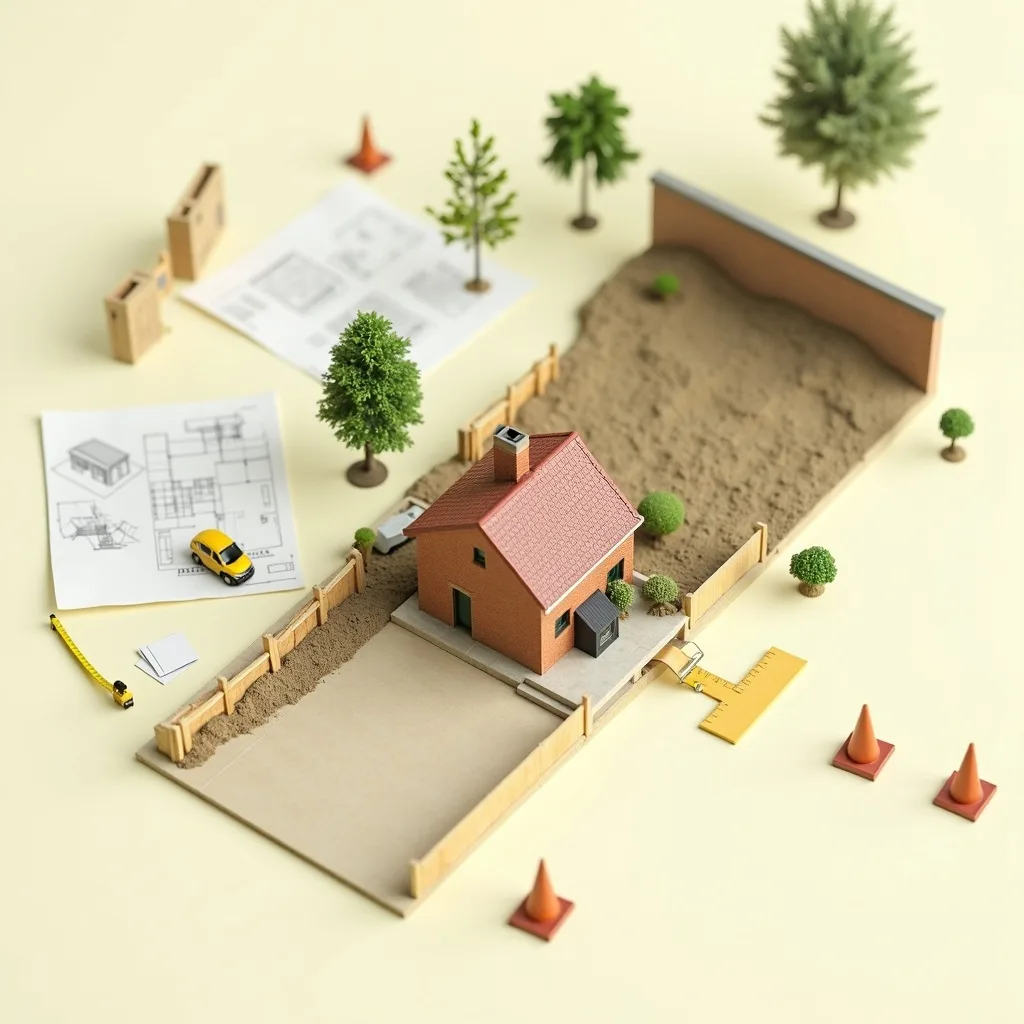
Piling lets you build near trees because it replaces wide, root-severing foundation trenches with narrow, load-bearing piles and a suspended ground beam that bridges over the root protection area (RPA) with minimal ground disturbance. It is the most common engineered answer to a foundation that has to sit close to a tree you are keeping.
If your scheme puts a building, extension or driveway inside or beside an RPA, a standard foundation is rarely acceptable. Piling, done properly and written into an approved method statement, often is. This guide explains how it works, what the local planning authority (LPA) expects to see, and where piling jobs near trees actually go wrong.
Why standard foundations fail near trees
A conventional strip or trench-fill footing is dug as a continuous trench, typically 0.6–1.2 m deep, and often deeper on shrinkable clay. Inside an RPA that does three damaging things at once:
- Severs structural roots the tree relies on for stability and water uptake. Most of a tree's absorbing roots sit in the top 600 mm of soil, precisely where a trench cuts.
- Compacts the surrounding soil as machinery and spoil sit on the rooting zone, collapsing the air and water spaces roots need to function.
- Changes ground levels, which can bury the root collar or expose roots — either of which stresses the tree.
BS5837:2012 sets the RPA as a circle with a radius of 12 times the stem diameter (measured at 1.5 m above ground), capped at 707 m² or a 15 m radius. Veteran and ancient trees get an enhanced area of 15 times stem diameter, or the canopy edge plus 5 m, whichever is larger. Excavating a continuous trench through that area is exactly what the standard is written to prevent, which is why tree officers reject applications that rely on ordinary footings inside an RPA without justification.
Remember the standard's status: BS5837 is guidance, a British Standard of recommendations, not law. Its teeth come from three separate places — the LPA's local validation list, any planning conditions attached to a permission, and statutory protection where a Tree Preservation Order or conservation area applies. Piling has to satisfy all of those, not just the engineering.
How pile-and-beam foundations work near trees
The engineering principle is to transfer the building load through the rooting zone rather than into it:
- Piles are installed at discrete points, so the ground is disturbed only at each pile position rather than along a continuous trench.
- A reinforced concrete ground beam spans between the pile caps, carrying the walls above so no load bears on the rooting soil between piles.
- A compressible void former (for example a proprietary cellular board) is often left beneath the beam so future root growth, clay heave and ground movement don't load the structure. On shrinkable clay this void is doing double duty — protecting the building from heave and the roots from the building.
Because the disturbed footprint is a fraction of a trench, the surviving root system stays largely intact. The arboriculturist and structural engineer agree pile positions together so piles miss the largest structural roots, and the number of piles is kept to the minimum the structure allows.
Pile types: screw, mini-pile and CFA
Different pile types suit different sites, and the arboricultural driver is always the same — least excavation, least tracking, least spoil over the RPA.
| Pile type | Why it suits work near trees | Watch-outs |
|---|---|---|
| Screw / helical piles | Augered in with almost no arisings; compact rigs; fast, low vibration | Load capacity limited; ground obstructions can deflect them onto roots |
| Mini-piles (small-diameter bored) | Small rigs, modest spoil, can thread between roots | Some spoil to control; needs careful setting-out around structural roots |
| CFA (continuous flight auger) | Quiet, low-vibration, no need to case the bore | Generates wet spoil that must be kept off the RPA; larger rig footprint |
| Driven piles | Fast, no spoil at all | Vibration and displacement can shear or crush shallow roots — usually the least tree-friendly |
The right choice depends on ground conditions and load, but the layout — where each pile lands relative to mapped roots — matters more to the tree than the pile type.
Worked example: rear extension over an oak's RPA
Take a single-storey rear extension where a neighbour's mature oak (stem diameter 600 mm) stands 3 m beyond the boundary. The RPA radius is 12 × 0.6 = 7.2 m, so the RPA overlaps the whole extension footprint. A trench-fill footing here would sever roots the neighbour's tree depends on — and because it is a neighbour's tree it may well be protected, turning a design problem into a potential criminal one.
The resolved scheme: mini-piles set out on a grid that the arboriculturist has checked against a root-mapping exercise, a suspended ground beam with a 100 mm void former beneath it, ground protection boards laid over the RPA before any rig tracks across it, and hand-dug pile inspection where a pile lands within 1 m of a mapped root so it can be nudged rather than sheared. The whole method — sequence, spoil handling, supervision — goes into the arboricultural method statement and is discharged as a pre-commencement condition before the rig arrives.
What the LPA actually wants to see
Piling is not a free pass. It is a mitigation measure that has to be evidenced. Expect to provide:
- A BS5837 tree survey and Tree Constraints Plan defining every RPA, including off-site and neighbouring trees whose RPAs cross into your site.
- An arboricultural impact assessment showing the conflict and why piling resolves it.
- An arboricultural method statement (AMS) detailing pile layout, rig access, spoil handling, ground protection over the RPA, hand-digging near roots, and the sequence of works.
- A Tree Protection Plan showing barrier fencing, the Construction Exclusion Zone and protected access routes.
The AMS is usually imposed as a pre-commencement condition: no works, including bringing the piling rig on site, may start until the LPA has approved it in writing. The LPA has a target period (commonly 8 weeks) to discharge the condition, and starting before it is discharged is a breach that can make the whole development unlawful. Site supervision by the arboriculturist during piling is frequently conditioned too, with visit records or certificates fed back to the tree officer.
Practical points that make or break a piling job near trees
- Rig access is the hidden risk. A well-designed pile layout is undone if a heavy rig tracks repeatedly across unprotected rooting soil. Ground protection boards or a temporary geocellular access route are usually essential — see our guide to no-dig construction and ground protection near trees.
- Spoil and concrete must be controlled. Arisings and wet concrete kept off the RPA; no washout into the rooting zone; a bunded, boarded area for mixing well away from roots.
- Hand-dig near large roots. Where pile positions or inspection pits fall close to structural roots, careful hand excavation lets the team reposition slightly rather than shearing a root.
- Keep the design honest. If the tree is protected by a Tree Preservation Order or sits in a conservation area, damaging its roots can be a criminal matter regardless of planning permission — check its status early with a TPO check.
- Sequence protection before piling. Barrier fencing and ground protection go in first; the rig arrives after the Construction Exclusion Zone is established, not before.
Requirements are set locally — check your council
There is no single national rule that dictates how much RPA incursion a piling design may take, what pile type is acceptable, or how supervision must be reported. Those expectations are set locally. The LPA's validation list decides whether the survey and AIA must be in the application to be registered at all, and the individual tree officer sets the bar for how the piling method statement is judged and discharged. One authority may accept a screw-pile solution on a light drawing; another will want root-mapping, a named supervising arboriculturist and photographic evidence at every stage.
Local variation is real, so confirm your own authority's requirements before you design the foundation. See how expectations differ on our council pages for Leeds, Manchester and Bristol, and start from the tree-surveys hub for your area. PlanWatch tracks live tree-related planning activity per council, so you can see how nearby applications involving trees and RPAs are actually being decided in your patch before you commit to a design. Note too that this is England-centric guidance — Scotland, Wales and Northern Ireland run parallel but distinct planning-and-tree regimes.
Bottom line
Piling turns "we can't build there because of the tree" into "we can build there and keep the tree", but only when the pile-and-beam design is developed jointly with the arboriculturist and structural engineer, backed by an approved method statement and real on-site protection. Get the tree survey done first so the RPA — the constraint every pile position must respect — is defined before the foundation is designed, and check what your specific council expects before you submit.