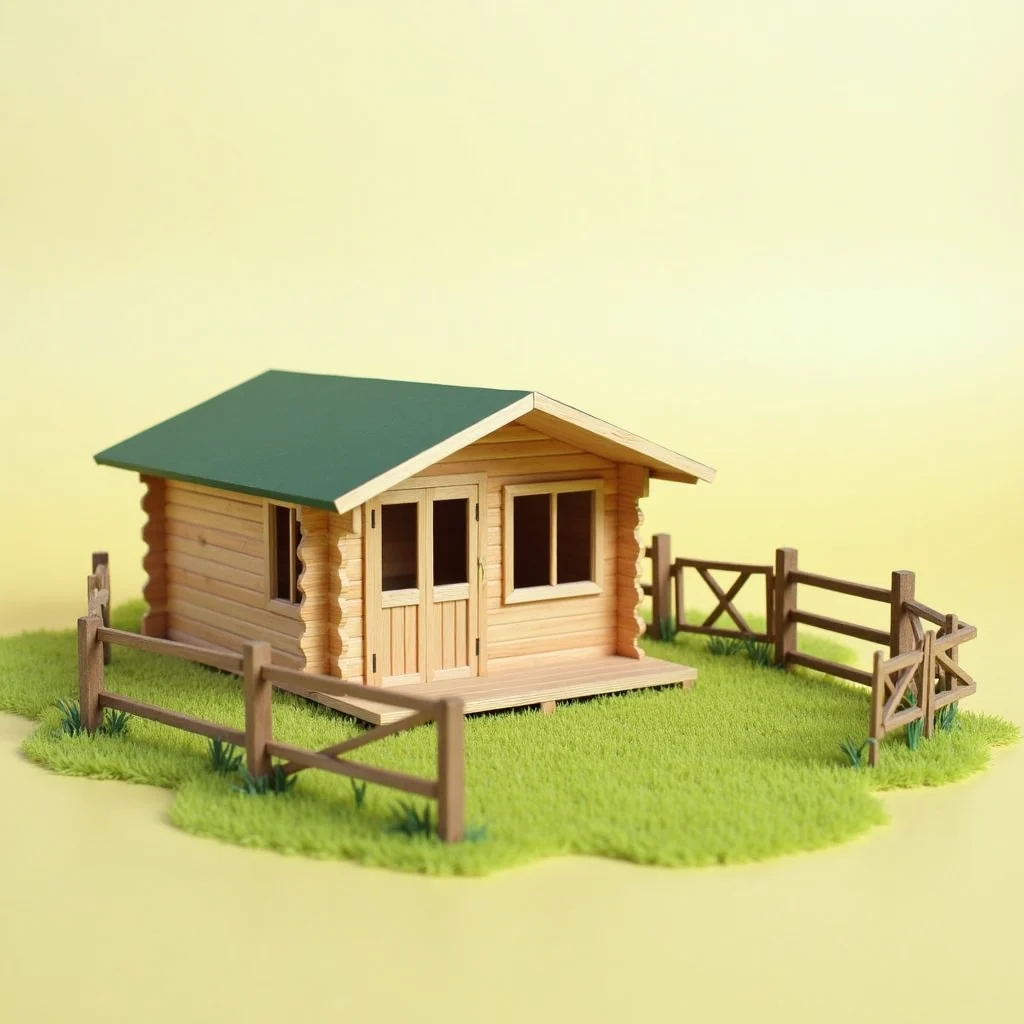
A log cabin on a bare field, paddock or agricultural land in England almost always needs full planning permission. The permitted development rights that let people build garden cabins without applying only exist "within the curtilage of a dwellinghouse" — land with no house attached to it has no curtilage, so those rights simply don't switch on. Agricultural permitted development is a separate, narrower right that never covers a dwelling or a living/leisure cabin.
Check what your council has actually approved or refused on agricultural and rural land near you before you commit: Search planning applications near you free ->
If you're starting from the basics of garden cabins, read our pillar guide first: Do I Need Planning Permission for a Log Cabin?
Quick Answer
| Situation | Planning position |
|---|---|
| Log cabin on a bare field or paddock, not attached to a house | Usually needs full planning permission |
| Cabin claimed as "agricultural" but used for living/leisure | Outside permitted development from the start — classic enforcement trigger |
| Genuine farm building on a qualifying unit (5ha+) | May be agricultural PD (Part 6, Class A), with prior approval — never a dwelling |
| Horse paddock, cabin for the owner to use | Usually its own change of use — equestrian use is not agriculture |
| Using the 28-day or campsite temporary-use rules to justify a cabin | Doesn't work — those cover temporary uses and moveable structures, not a fixed building |
| Converting an existing barn into a home | Possibly Class Q — does not apply to a new-build cabin |
| Field is in the Green Belt | New cabin is normally "inappropriate development" — high bar to overcome |
Why Householder Permitted Development Doesn't Apply Off-Curtilage
The right that lets most people build a garden cabin without applying sits in GPDO Schedule 2, Part 1, Class E — outbuildings incidental to the enjoyment of a dwellinghouse. That whole part of the Order is headed "development within the curtilage of a dwellinghouse."
A bare field, paddock or block of agricultural land has no dwellinghouse attached to it, so it has no curtilage for that right to operate on. Curtilage is a factual planning test — land intimately associated with and serving a house — not "everything you own." A large paddock is typically not curtilage even where it adjoins your garden, sits across a lane, or was bought as a separate parcel.
The consequence is straightforward: a garden-style cabin, summerhouse or log cabin that would be perfectly lawful behind your house is not permitted development on a separate field, however similar it looks. Without a different permitted development right genuinely applying, it needs full planning permission — both for the building itself and, usually, for the change of use of the land.
Agricultural Permitted Development (Part 6) — What It Actually Allows
Agricultural land does have its own permitted development regime, GPDO Schedule 2, Part 6, but it is much narrower than people assume — and it does not cover a cabin to live or holiday in.
- Class A applies to an agricultural unit of 5 hectares or more. It can permit erecting, extending or altering a building, but only where reasonably necessary for the purposes of agriculture. New buildings under Class A are capped at a ground area of 465 square metres, a height of 12 metres (3 metres near an aerodrome), and require prior approval to the council on siting, design and appearance before work starts.
- Class B applies to smaller units, 0.4 up to 5 hectares. It is more limited still — it only allows extension or alteration of an existing agricultural building. It does not permit a new building at all.
- Both classes expressly exclude dwellings. The Order rules out development that consists of, or includes, the erection, extension or alteration of a dwelling.
A structure built to live in, sleep in, holiday in, or simply relax in fails the "reasonably necessary for agriculture" test outright — it makes no difference how it's labelled on a delivery invoice.
The Classic Trap: Call It "Agricultural," Then Live In It
The most common way people end up in enforcement is building something described as an agricultural store, workshop or shepherd's hut, then using it as accommodation. This fails on two separate counts:
- If the real purpose was residential all along, it was never within the agricultural PD right in the first place — the "agricultural" cabin was unlawful from day one.
- Even where a genuine agricultural building was lawfully built, starting to live in it is a material change of use to residential, which is separately unlawful and needs its own permission.
Councils actively look for this pattern, and the evidence is rarely subtle: beds, a kitchen, a bathroom, post redirected to the address, vehicles parked overnight, a council tax registration, or residential-style planting and fencing around the building. Once that evidence exists, the "it's for the farm" argument tends to collapse quickly.
Paddocks and Horses: Equestrian Use Is Not Agriculture
A horse paddock is a special case, and it catches out a lot of horse owners. Genuinely grazing horses — turned out to eat grass with no supplementary regime — can sit within the statutory definition of agriculture. But once horses are kept, exercised, schooled or ridden for leisure or competition, that is treated as an equestrian use, which is separate from agriculture in planning terms.
That distinction matters for two reasons:
- Introducing recreational horse-keeping onto grazing land can itself be a change of use requiring permission.
- Because the land is no longer "agricultural" in the planning sense, agricultural permitted development (Part 6) generally does not apply to it at all — so a cabin on a leisure horse paddock has no fallback agricultural PD argument.
A genuinely moveable field shelter, sited for animal welfare and actually moved around rather than fixed in place, may sometimes escape control as a chattel rather than a building. A fixed tack room, stable block, or a habitable log cabin with a base and services is a different matter entirely — it is a building and/or a change of use, and it needs permission.
Temporary Uses (28 Days, Campsites) Don't Cover a Permanent Cabin
GPDO Schedule 2, Part 4 gives some limited temporary-use rights, and it's worth ruling these out clearly because they're often misquoted as a loophole:
- Class B allows land to be used for any purpose for up to 28 days in total per calendar year (14 days for markets or motor racing), and permits a moveable structure for that temporary use only.
- Class BC allows temporary recreational campsites for up to 60 days per year and up to 50 pitches, again with moveable structures and notification to the council.
Neither covers a permanent, fixed log cabin. Both rights are about a temporary use of the land and moveable structures that support it — not a building left in place year-round. Leaving a cabin up permanently, or running a continuous use from it, goes beyond what either right allows.
Class Q Converts Existing Buildings, Not New Cabins
Class Q permitted development lets a genuinely existing agricultural building be converted into a home, subject to conditions and a prior approval process. It is sometimes misunderstood as a general licence to create a home on farmland. It is not: there has to be a qualifying agricultural building already standing and structurally capable of conversion. Class Q gives you no route to erect a new log cabin on a bare field.
Green Belt Sensitivity
If the land sits in the Green Belt, the position is harder still. National planning policy treats the construction of new buildings as inappropriate development in the Green Belt — harmful by definition — unless it falls within a limited list of exceptions, such as genuine agricultural and forestry buildings or certain outdoor sport and recreation facilities. A residential or leisure log cabin does not sit within those exceptions.
Inappropriate development can only be permitted where "very special circumstances" clearly outweigh the harm to the Green Belt — a demanding test that a private cabin rarely meets. Even a genuinely agricultural building still has to respect the openness of the Green Belt and be a proportionate, real farming need. (See the NPPF's Green Belt chapter.)
The Realistic Routes
- Full planning application — the default, and usually the only realistic route for a habitable or leisure cabin on non-curtilage land. It's assessed on planning merits, weighing the rural location, isolation, openness and local plan policy.
- Genuine agricultural prior approval (Part 6) — only where the structure really is reasonably necessary for a working farm business on a qualifying unit, and does not include any element of a dwelling.
- Rural-worker dwelling (NPPF) — the NPPF's chapter on housing supply allows a narrow exception for an isolated new home in the countryside where there's an essential need for a rural worker to live permanently at or near their place of work. This carries a high evidential bar, usually starts with a temporary consent, and comes with an agricultural occupancy condition restricting who can live there.
- Class Q conversion — only relevant if there is already a qualifying agricultural building on site to convert; it gives no help for a bare field.
Area Examples
In predominantly rural authorities such as Cornwall and areas around the Lake District, fields and paddocks sit close to landscape designations, and councils scrutinise anything that looks like a rural home in disguise — including cabins marketed as "agricultural" or "mobile." In more mixed rural-urban authorities like Chelmsford, the pressure point is usually paddocks on the edge of settlements being used for leisure horses or weekend cabins without permission. Search your own council to see how similar cases nearby were decided: /planning.
Frequently Asked Questions
I own the field — can't I just put a log cabin on it?
No. Ownership doesn't create a planning right. Householder permitted development only applies within the curtilage of a dwellinghouse, and a bare field has no curtilage. A habitable or leisure log cabin on agricultural land normally needs full planning permission, plus a change of use of the land itself.
It's for my farm — isn't an agricultural building permitted development?
Agricultural permitted development (GPDO Part 6) can allow genuine farm buildings on qualifying units, but it expressly excludes dwellings and only covers what is reasonably necessary for agriculture. A cabin to live, sleep or relax in does not qualify.
Can I use the 28-day rule to keep a cabin on my land?
No. The 28-day temporary use right (Part 4 Class B) covers a temporary use of land and only moveable structures for that use. A permanent, fixed log cabin left up year-round falls outside it entirely.
It's a paddock for my horses — do the same rules apply as a farm?
Not necessarily. Keeping or exercising horses for leisure is usually treated as equestrian use, not agriculture, which is often itself a change of use needing permission. Agricultural permitted development generally will not apply to that land.
Does Class Q let me put a new cabin on agricultural land?
No. Class Q only allows conversion of an existing agricultural building into a home. It does not authorise building a new log cabin on a bare field.
My land is in the Green Belt — does that make it harder?
Yes. New buildings are treated as inappropriate development in the Green Belt unless a narrow exception applies, and a residential or leisure log cabin usually isn't one of them. Consent generally requires very special circumstances.
What if I've already built a cabin on my field?
You can apply for retrospective planning permission, but approval isn't guaranteed and refusal can lead to enforcement action requiring removal. See retrospective planning permission and planning enforcement when rules are broken.
Check Your Area
Before committing to a cabin on a field or paddock, see how your council has actually treated similar rural and agricultural cases — approvals, refusals, and enforcement outcomes.
Search planning applications free ->
Further Reading
Want to know if there's a planning application near you?
Enter your postcode to see what's been submitted in your area — completely free.
Search Your Postcode FreeDisclaimer: PlanWatch provides general information about UK planning processes. This content is not legal advice. Planning law is complex and varies by local authority. Consult a qualified planning consultant or solicitor for advice specific to your situation.