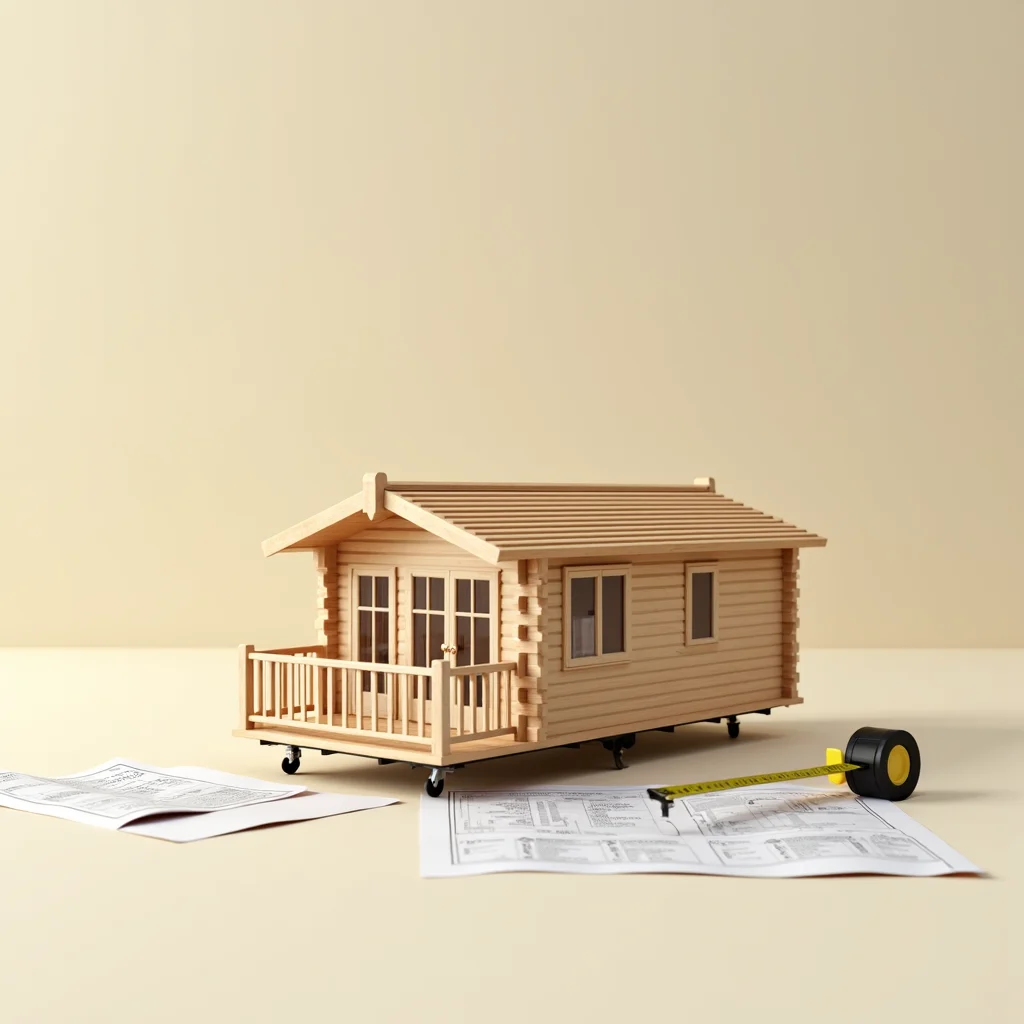
A log cabin can be legally a "caravan" if it meets a precise statutory test — but that only settles whether putting it up is a building operation, not whether you can live in it or let it out. Twin-unit lodges up to 20 metres long, 6.8 metres wide and 3.05 metres internal height can still count as caravans in law, however permanent they look. The trap is assuming that status alone gives you a free pass to use the land however you like.
Check what's already been approved or refused near you before you commit: Search planning applications near you free ->
Quick Answer
| Situation | Planning position |
|---|---|
| Structure meets the caravan definition and mobility test | Siting it is usually not a building operation |
| Twin-unit lodge within 20m x 6.8m x 3.05m, two sections, movable | Legally a caravan, regardless of appearance |
| Exceeds any dimension, or more than two sections | A building — full planning and building regs analysis applies |
| Caravan incidental to your home, within its curtilage | Usually no permission needed for the use |
| Living in the caravan as a separate home | Change of use — usually needs permission |
| Letting the caravan as a holiday let / Airbnb | Often a change of use — see holiday-let rules |
| Caravan on a field or paddock, not house curtilage | Change of use of the land — usually needs permission, plus a site licence for habitation |
For the underlying outbuilding rules a log cabin normally falls under, see the pillar guide: Do I need planning permission for a log cabin?
Why This Matters
Most log cabins are assessed as outbuildings under permitted development. But a structure that also happens to meet the legal definition of a caravan is treated differently: siting a genuine caravan is not normally a "building operation" in the way constructing a fixed cabin is, because the caravan test asks whether the unit is designed and capable of being moved, not built. That can matter for anyone weighing up a large twin-unit lodge instead of a site-built cabin — it opens a different legal route into having a substantial garden or holiday structure without treating it as construction.
The catch, covered below, is that this route only ever answers the "is putting this here a building operation" question. It never by itself answers "am I allowed to live in it or let it out."
The Legal Definition of a Caravan
The starting point is the Caravan Sites and Control of Development Act 1960, s.29(1):
A "caravan" means any structure designed or adapted for human habitation which is capable of being moved from one place to another (whether by being towed, or by being transported on a motor vehicle or trailer) — but does not include railway rolling stock on rails forming part of a railway system, or a tent.
Two limbs have to be satisfied together: the structure must be designed or adapted for human habitation, and it must be capable of being moved — towed, or carried on a vehicle or trailer. A single-unit structure delivered whole on a lorry and craned into place, or one still on a chassis and wheels, typically satisfies both.
The Twin-Unit Test: Exact Size Limits
Larger lodges assembled on site from two halves are covered separately by the Caravan Sites Act 1968, s.13, as amended. A structure qualifies as a caravan under this test only if it meets all of the following, in England:
- Length: maximum 20 metres, excluding any drawbar
- Width: maximum 6.8 metres
- Internal height of the living accommodation: maximum 3.05 metres, measured floor to ceiling
- Composed of no more than two sections, separately built and designed to be joined on site by bolts, clamps or similar devices
- Physically capable of being moved by road once assembled
These metric figures were substituted by SI 2006/2374, in force in England from 1 October 2006. They replaced the older imperial-derived limits (roughly 18.29m x 6.10m x 3.05m). If you see "18m x 6m x 3m" quoted as the current caravan size limit, that figure is out of date for England — do not rely on it.
Exceed any one of these dimensions, or need more than two sections to assemble the unit, and it stops being a caravan in law. It becomes a building, and the ordinary planning and building regulations analysis for a fixed structure applies instead — see the pillar guide on log cabin planning permission.
The Mobility Test
Both limbs of the law — the 1960 base definition and the 1968 twin-unit rule — turn on mobility, not on whether the unit is actually moved:
- A single-unit structure must be capable of being towed or carried on a vehicle or trailer.
- A twin-unit lodge must be assembled from no more than two sections and, once assembled, remain physically capable of being moved by road.
It is the capacity to be moved that counts. The unit can sit on blocks or a base indefinitely and never actually travel again — that doesn't disqualify it. What does disqualify it is being bolted to permanent foundations, built from more than two sections, or built too large to travel by road at all.
Statutory Definition Beats Everyday Meaning
A large twin-unit lodge can look, from the outside, exactly like a permanent building — timber cladding, a proper roof, decking, the works. That appearance is irrelevant to the legal test. In Wyre Forest District Council v Secretary of State for the Environment [1990], the House of Lords confirmed that the statutory definition in the 1960 and 1968 Acts governs whether something is a caravan for planning purposes — not the everyday, common-sense meaning of the word. A chalet-style structure that met the statutory test was held to be a "caravan," however solid it looked.
This is the anchor case for the whole area: whether your lodge is a caravan or a building is decided by measuring it against s.29(1) and s.13, not by how it would strike a passer-by.
Meeting the Test Doesn't Cover the Use
This is the trap that catches people out. Qualifying as a caravan only settles the structure question — that siting it isn't a building operation. It does not authorise the use you put the land or the caravan to:
- Living in the caravan as a separate home. Once a caravan is occupied as an independent, self-contained residence — separate from the main house — that is typically a material change of use of the land, needing planning permission in its own right. See planning permission for mobile homes.
- Letting the caravan out. Holiday-letting or renting a caravan as standalone accommodation can also be a material change of use, judged on the same fact-and-degree basis as any other holiday let — see log cabin planning permission for Airbnb / holiday lets.
- Siting a caravan on open land. A caravan on a field or paddock that isn't residential curtilage is a change of use of the land itself, and if used for human habitation the site will usually also need a site licence under the 1960 Act, separate from planning permission. See planning permission for change of use.
In short: the structure can be permission-free while the use is not. The caravan route helps with the building-operation limb; it never automatically legalises living in it or running it as a business.
Siting a Caravan Incidental to Your Home
Where the caravan status genuinely helps is the ordinary domestic case. Stationing a caravan within the curtilage of your house, and using it for something incidental to enjoying that dwelling — storage, a hobby space, a home office, occasional overspill for guests who remain part of your household — generally stays within your existing residential use. No material change of use, and usually no permission needed for the use, on top of the caravan not being a building operation.
That protection disappears the moment the caravan becomes a separate household in its own right, whether that's someone living there full-time or the unit being let commercially. If you're weighing that line for a log cabin generally, rather than a true caravan, see can I live in a log cabin in my garden.
Area Examples
In landscape-sensitive areas like Cornwall and the Lake District, twin-unit lodges marketed as "caravans" are common on holiday sites, and councils scrutinise both the size test and the use closely, especially where a lodge looks capable of year-round residential occupation rather than holiday use. In ordinary residential areas such as Sheffield and Bristol, the question more often comes down to whether a garden caravan has quietly turned into someone's separate home. Search recent applications and enforcement cases near you to see how your council actually treats these.
Frequently Asked Questions
Is a log cabin legally a caravan?
It can be, if it meets the statutory definition — designed for human habitation, capable of being moved, and, for larger twin-unit lodges, assembled from no more than two sections within the maximum dimensions of 20 metres long, 6.8 metres wide and 3.05 metres internal height. Appearance doesn't decide it; the law does.
What size can a twin-unit lodge be and still count as a caravan in England?
Up to 20 metres long (excluding the drawbar), 6.8 metres wide, and 3.05 metres internal floor-to-ceiling height, assembled on site from no more than two sections and still physically capable of being moved by road. These are the England figures in force since 1 October 2006 — older sources quoting 18m x 6m x 3m are out of date.
If my log cabin counts as a caravan, do I still need planning permission?
Often yes, for the use rather than the structure. Meeting the caravan definition generally means siting it isn't a building operation, but living in it, letting it as a separate home, or holiday-letting it can still be a material change of use needing permission.
What's the legal test for a caravan?
Under the Caravan Sites and Control of Development Act 1960 s.29(1), a caravan is a structure designed or adapted for human habitation that is capable of being moved from one place to another, whether towed or transported on a vehicle or trailer. It excludes railway rolling stock and tents.
Can a large log cabin really count as a caravan even though it looks like a building?
Yes. In Wyre Forest District Council v Secretary of State for the Environment [1990], the House of Lords confirmed that the statutory definition governs, not everyday meaning — a chalet-like structure within the legal definition was a caravan for planning purposes, however permanent it looked.
Can I put a caravan in my garden without planning permission?
Usually yes, if it stays within the curtilage of your house and is used for something incidental to enjoying the home. It becomes a planning matter the moment it's used as a separate, self-contained home or let out.
Does a caravan need a site licence as well as planning permission?
If land is used as a caravan site for human habitation, a site licence is generally needed from the council under the Caravan Sites and Control of Development Act 1960, in addition to any planning permission for the use.
Check Your Area
Before relying on caravan status for a lodge or mobile home, see how your council has actually treated similar cases — approvals, refusals, and enforcement over separate occupation.
Search planning applications free ->
Further Reading
Want to know if there's a planning application near you?
Enter your postcode to see what's been submitted in your area — completely free.
Search Your Postcode FreeDisclaimer: PlanWatch provides general information about UK planning processes. This content is not legal advice. Planning law is complex and varies by local authority. Consult a qualified planning consultant or solicitor for advice specific to your situation.