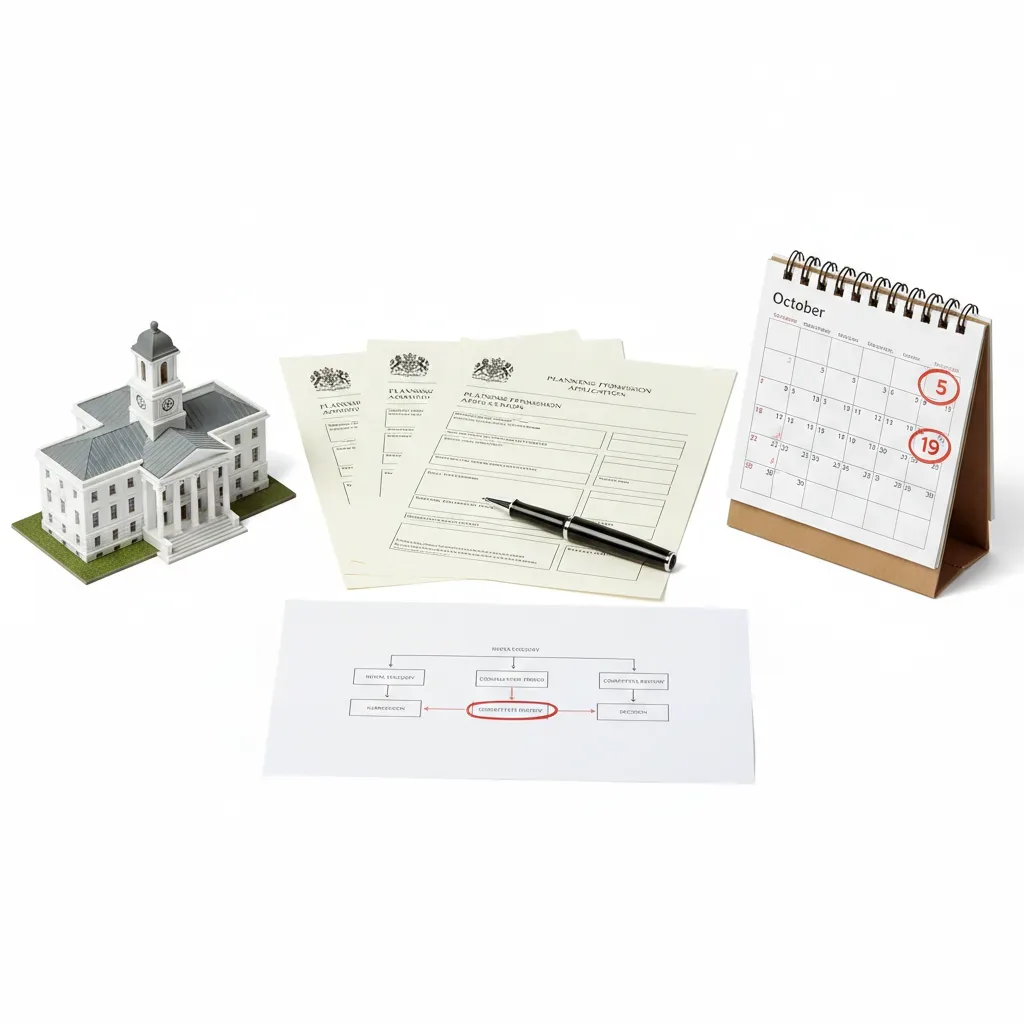


A Local Plan is the legal blueprint your council uses to decide where new housing, employment, retail and infrastructure can go over the next 15 to 20 years. Every planning application in your area is judged against it. Local Plans allocate specific sites for development, set design policies, protect the Green Belt and conservation areas, and decide how much new housing the council must deliver each year. They are produced by your Local Planning Authority, examined by an independent Planning Inspector, and reviewed at least every five years.
If you have ever wondered why a field on the edge of your village was suddenly approved for 200 homes — or why an extension you thought was reasonable was refused — the answer almost always sits in the Local Plan. It is the single most important planning document in your area, and yet most homeowners only discover it exists when a development is already proposed.
The GOV.UK guide on plan-making is the official starting point. The National Planning Policy Framework sits above it. This guide explains how Local Plans actually work in 2026, how to read one, and how to engage with the process before the development pressure arrives.
What A Local Plan Is, Plainly
A Local Plan is a statutory document produced by each Local Planning Authority in England. Wales, Scotland and Northern Ireland each have their own equivalents — the Welsh Local Development Plan (LDP), the Scottish Local Development Plan, and the Northern Ireland Local Development Plan. The principles are the same: a long-term, legally binding document that decides what gets built where.
A Local Plan does several things at once:
- It sets a vision for the area — population growth, jobs, transport, environment, design.
- It sets a housing target based on the standard method calculated under national policy.
- It allocates specific sites for housing, employment, retail and infrastructure.
- It writes policies that planning officers and committees use to assess individual applications — design standards, parking, daylight, conservation, heritage, biodiversity, flooding.
- It designates protected areas — Green Belt, Conservation Areas, Areas of Outstanding Natural Beauty, Local Wildlife Sites.
Once adopted, a Local Plan has full statutory weight. Section 38(6) of the Planning and Compulsory Purchase Act 2004 requires planning applications to be decided in accordance with the Development Plan unless material considerations indicate otherwise. The Local Plan is the development plan.
The Five Stages Of A Local Plan
Most Local Plans pass through five stages from start to adoption. The whole process typically takes three to five years.
Stage 1 — Evidence Base And Call For Sites
Before any drafting, the council assembles an evidence base: housing need assessment, employment land study, infrastructure delivery plan, transport assessment, retail capacity study, environmental and heritage surveys, flood risk assessment, and the Strategic Housing and Employment Land Availability Assessment (SHELAA). At the same time, councils invite landowners and developers to submit sites for consideration — the Call For Sites.
This is the quietest stage but it shapes everything that follows. Sites entered into the SHELAA at this point become candidates for allocation later.
Stage 2 — Regulation 18 Issues And Options Consultation
The first public consultation. The council publishes draft options — sometimes alternative scenarios, sometimes a preferred direction — and invites comments from residents, businesses, parish councils and statutory consultees. This is the stage at which the strategic direction is still moveable. Comments at this stage carry weight because the plan has not yet been written.
Stage 3 — Regulation 19 Pre-Submission Consultation
The council publishes the full draft plan it intends to submit for examination. The consultation is narrower — comments must focus on whether the plan is sound (positively prepared, justified, effective, consistent with national policy) and legally compliant. The threshold for changing the plan at this stage is higher, but objections lodged here are the ones the Planning Inspector will consider at examination.
Stage 4 — Submission And Examination In Public
The council submits the plan to the Secretary of State, who appoints an independent Planning Inspector. The Inspector holds an Examination in Public — a series of hearings, usually over several months, at which the council, objectors, developers and other parties make their case. The Inspector tests the soundness of the plan, particularly the housing numbers, site allocations and key policies.
The Inspector can recommend Main Modifications to make the plan sound. Councils almost always accept these to secure adoption.
Stage 5 — Adoption
After the Inspector's report, the council holds a full council vote to formally adopt the plan. Once adopted, it replaces any previous Local Plan and becomes the development plan for the area.
What A Local Plan Actually Contains
A typical modern Local Plan runs to several hundred pages, often split into a written document, a Policies Map, and a Sustainability Appraisal. Inside the document, expect to find:
- A vision and strategic objectives — usually the first ten pages.
- A spatial strategy — how growth is distributed across the area (Settlement Hierarchy).
- A housing requirement and trajectory — the number of homes per year, where they will go, and the rolling five-year housing land supply.
- Site allocations — individual sites identified for development, often labelled (for example, H1, H2, E1, E2 for housing and employment).
- Strategic policies — Green Belt boundaries, conservation areas, town centre boundaries, transport corridors.
- Development management policies — the criteria officers use to decide individual applications. Design, density, parking, daylight, biodiversity net gain, heritage, flood risk, affordable housing percentage.
- A Policies Map — the visual layer that shows every designation on the ground.
The Policies Map is what most homeowners actually need. It shows whether a field near you is allocated for housing, whether your road is in a Conservation Area, whether your back garden falls within an Article 4 direction, and whether the next-door site is safeguarded for employment use.
How To Find Your Local Plan
Every council publishes its Local Plan on its website, usually under "Planning" or "Planning Policy". Search "[your council] Local Plan" and look for the most recently adopted version. Many councils also publish:
- A consolidated Policies Map that you can search by address.
- An Annual Monitoring Report (AMR) showing how the plan is performing against its housing trajectory.
- Evidence-base documents (SHELAA, housing needs assessment, etc.).
If your council is in the middle of producing a new Local Plan, the emerging plan carries weight too — typically less than the adopted plan but more than nothing. Section 49 of the Planning and Compulsory Purchase Act 2004 explains how weight is determined: the further through the process a plan has progressed, the more weight it carries.
Local Plan vs Neighbourhood Plan vs Supplementary Planning Document
These three terms cause more confusion than almost any other in planning policy. Quick clarification:
- Local Plan — statutory, produced by the council, covers the whole council area, has full development plan weight.
- Neighbourhood Plan — statutory, produced by a parish council or neighbourhood forum, covers a designated neighbourhood area, must be in general conformity with the Local Plan, has full development plan weight once made.
- Supplementary Planning Document (SPD) — non-statutory guidance that elaborates on Local Plan policies. Lower weight than a Local Plan or Neighbourhood Plan.
A site can be subject to all three at once — and where they conflict, the most recent and most specific usually wins, but the Local Plan strategic policies almost always take precedence on strategic matters.
The Five-Year Housing Land Supply Rule
The single most important policy lever in any Local Plan is the five-year housing land supply test. Councils are required to demonstrate they have a deliverable supply of housing sites equivalent to at least five years of housing need.
If a council cannot demonstrate a five-year supply, paragraph 11d of the NPPF kicks in — the "tilted balance" — and planning permission must be granted for sustainable development unless the adverse impacts significantly and demonstrably outweigh the benefits. In practical terms, this means a council without a five-year supply loses many of its tools for refusing speculative housing applications.
This is why housing target numbers are politically contested at the examination stage, and why developers focus their applications on councils with a weak supply.
How To Engage With Your Local Plan
If a Local Plan affects you — and it will, sooner or later — there are five practical engagement points:
- Submit your site or your views at the Call For Sites and Regulation 18 stage. This is where the plan is still being shaped. Engagement at this stage carries the most weight.
- Sign up for council planning policy alerts. Most councils run a notification list for plan-making consultations.
- Work with your parish council or neighbourhood forum. A coordinated parish response is much more weighty than 50 individual emails.
- Lodge a Regulation 19 objection if a site near you is allocated. This is your ticket to participate in the Examination in Public. Without a Reg 19 objection, you cannot speak at the hearings on that site.
- Watch the Annual Monitoring Report. When housing delivery falls behind, the tilted balance can return and unallocated sites become harder to refuse.
Common Mistakes Residents Make
Do not assume that because the council promised something in a planning press release it will be in the Local Plan. Promises only have weight once written as policy and adopted.
Do not wait until a specific application appears. By the time an allocated site comes forward, the principle of development has already been settled in the Local Plan — objections at planning application stage cannot reopen it.
Do not ignore the Sustainability Appraisal. Many strategic challenges to plan policies succeed on Sustainability Appraisal grounds when the merits of the policy were never going to win.
Do not confuse Green Belt with Conservation Area or AONB — they protect different things in different ways. The Local Plan's Policies Map shows which applies where.
What Has Changed In 2026
The Labour government's 2024–25 planning reforms restored a binding standard-method housing target, raised national targets significantly, and reduced the use of "exceptional circumstances" arguments to depart from them. Many councils are now mid-review under the new framework. If your council adopted a plan before 2024, expect a review to be underway — and expect housing numbers in your area to be revised upward.
The NPPF was revised in December 2024 to give significantly more weight to the standard housing method and to restrict the grounds on which councils can constrain Green Belt release. The "grey belt" concept introduced in 2024 — previously developed or low-quality land within the Green Belt — is now an allocation category in newer plans.
Official Sources
- GOV.UK plan-making guidance
- National Planning Policy Framework
- Planning Inspectorate examination procedure
- Planning and Compulsory Purchase Act 2004
Related PlanWatch Guides
- What Are Material Planning Considerations
- Permitted Development Rights Explained
- Planning Permission Process Complete Guide
- Conservation Areas And Planning
- How To Object To A Planning Application
Frequently Asked Questions
What is a Local Plan?
A Local Plan is the legal document that sets out how a council will manage development across its area over a 15-20 year period. It allocates land for housing, employment, retail, and infrastructure, and contains the policies councils use to decide individual planning applications.
How long does a Local Plan last?
Most Local Plans cover a 15-20 year period and are reviewed at least every five years. Councils are legally required to update Local Plans that have become out of date relative to national policy.
Can I object to a Local Plan?
Yes. Every Local Plan goes through statutory consultation stages — typically a Regulation 18 Issues and Options consultation, a Regulation 19 Pre-Submission consultation, and an Examination in Public hearing by a Planning Inspector. Residents and local groups can submit comments at each stage.
What is the difference between a Local Plan and the NPPF?
The NPPF (National Planning Policy Framework) is the government's national policy applied across England. A Local Plan applies it to a specific council area, allocating sites and writing local policies. Where a Local Plan is silent or out of date, the NPPF takes precedence.
Does a Local Plan affect my house?
It can. Local Plans designate Green Belt, Conservation Areas, employment land, housing allocations, flood zones, and other policies that directly affect what you can build, demolish or convert. They also affect the value and uses of nearby land.
Who writes the Local Plan?
The Local Planning Authority (your council's planning department) drafts the plan with input from elected members, statutory consultees (Highways England, Environment Agency, neighbouring councils), residents, landowners, developers, and Planning Aid. It is then examined by an independent Planning Inspector before adoption.
The Sensible Test
If you want to know what your area will look like in fifteen years, read the Local Plan before you read the planning applications. If you want to influence it, engage at Regulation 18, not Regulation 19. And if a developer is pushing a site near you, the first question to answer is whether it is allocated in the adopted plan — because almost everything that follows turns on that single fact.
Want to know if there's a planning application near you?
Enter your postcode to see what's been submitted in your area — completely free.
Search Your Postcode FreeDisclaimer: PlanWatch provides general information about UK planning processes. This content is not legal advice. Planning law is complex and varies by local authority. Consult a qualified planning consultant or solicitor for advice specific to your situation.